
The space strategist said that this shows that one should not take anything for granted in space exploration.

Only three countries (United States, Russia and China) have successfully landed spacecraft on the airless lunar surface.

He noted that Chandrayaan-3 will be inserted into the lunar transfer trajectory after the orbit raising manoeuvres.

The role of the space sector in armed conflicts came into sharp focus during Operation Sindoor, which saw extensive use of drones and loitering munitions and tested the capabilities of air defence systems such as indigenously developed Akash Teer.

Chandrayaan-3 mission's rover 'Pragyan' has traversed a distance of about eight metres on the lunar surface, and its payloads have been turned on, ISRO said on Friday.
This is the third time that Tamil Nadu has supplied the necessary soil to the Bengaluru headquartered space agency for performing the tests for its ambitious Moon missions.

The crater was formed during the Nectarian period, which dates back to 3.85 billion years and is one of the oldest time periods in the Moon's history, the team, including researchers from the Physical Research Laboratory and Indian Space Research Organisation (ISRO), Ahmedabad, said.
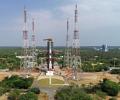
The Aditya-L1 mission carries seven scientific payloads to carry out the study.

Somanath thanked all those who prayed for the mission's success, and ISRO veterans like A S Kiran Kumar , the space agency's former chief.

India's ambitious third Moon mission's spacecraft Chandrayaan-3 after the launch on July 14, had entered into lunar orbit or the Moon's orbit on August 5.
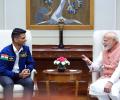
Shukla said the two missions presented a major opportunity for the country and the sustained commitment of the government to the space sector, despite setbacks such as the Chandrayaan-II mission was laudable.

Weighing 320 tonne at lift-off, the vehicle used larger strap-on motors to achieve higher payload capability.

The Orion capsule returns to earth after a 26 day mission orbiting the Moon and back.

Chandrayaan 3 follows the Chandrayaan 2 mission which did not achieve the desired soft landing on the surface of the moon in 2019, disappointing the scientists.

People gathered in educational institutions, offices, city squares and religious places to watch the Indian Space Research Organisation's live telecast of Chandrayaan-3's final descent to the uncharted surface of the lunar south pole.
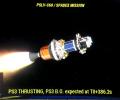
Dubbed as a prelude to ISRO setting up its own Space Station by 2035, the PSLV-C60 mission would also make India join an elite club in achieving this feat which is expected to take place in the coming days.

Vikram and Pragyan payloads are now in a power-off mode until the south pole of the lunar surface is back in the range of the Sun again.
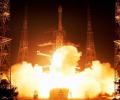
ISRO is part of an exclusive league which has forayed into the Moon and Sun.

'Our vision for the future includes the creation of an active ecosystem, human space flight, a human space station.'
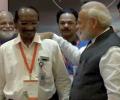
Minutes before making the announcement about losing communication with the 'Vikram' lander, ISRO Chairman K Sivan briefed the prime minister.
The race to the uncharted south pole of the Moon is quickening with India's Chandrayaan-3 and Russia's Luna-25 gearing up for lunar landings next week, each mission holding significant implications beyond the thrilling competition in the skies.

The Human-rated LVM3 vehicle, the Crew Escape System and the Crew Module and Service Module are all in final stages of testing and integration.
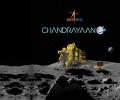
Sachin Tendulkar, Sania, Mirza, Anil Kumble and Virat Kohli hailed Moon mission Chandrayaan-3's successful landing
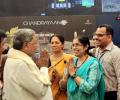
Even as the scientists and staff at Mission Operations Complex broke into applause, the core team members thanked all those who had worked on the mission. Quietly and without jingoistic boasting of their stupendous achievement. And that is the most remarkable aspect of ISRO -- they let their work do the talking, notes Minnie Vaid, author of Those Magnificent Women And Their Flying Machines, ISRO's Mission to Mars.
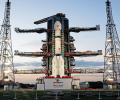
The imaging technology in Nisar can provide very high-resolution data on changes as small as one centimetre in size on the earth's surface.

Docking technology is crucial for sending people and cargo to space stations.

Group Captain Shubhanshu Shukla, India's second astronaut, shares his journey from a shy child hearing stories of Rakesh Sharma to becoming part of the Axiom-4 mission to the International Space Station. He emphasizes the role of the IAF in his transformation and inspires India's youth to explore space.

ISRO Chairman V Narayanan announced the development of a massive rocket capable of placing 75,000 kg payloads in low earth orbit, highlighting India's growing space capabilities and future satellite launches.

The New York Times, The Washington Post, The BBC and The Guardian, among many other leading foreign media outlets, all carried stories on Chandrayaan-2, India's landmark moon mission.

According to the space agency, Chandra's Surface Thermophysical Experiment measured the temperature profile of the lunar topsoil around the south pole, to understand the thermal behaviour of the Moon's surface.

Unveiling his launch day playlist, the Indian pilot revealed that he loves to listen to Shah Rukh Khan's Swades song Yuh Hi Chala Chal.

The rover will carry out in-situ chemical analysis of the lunar surface during the course of its mobility.
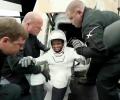
Astronaut Shubhanshu Shukla and the Axiom-4 mission crew safely returned to Earth after an 18-day stay at the International Space Station, splashing down off the coast of San Diego.
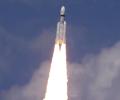
For the Gaganyaan programme, LVM3 rocket is re-configured to meet the human rating requirements and has been christened as 'Human Rated LVM3', ISRO said and it would be capable of launching the Orbital Module to an Low Earth Orbit of 400kms.
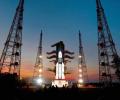
Of the 109 lunar missions during the period, 61 were successful and 48 had failed, it stated.
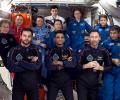
The family of astronaut Shubhanshu Shukla in Lucknow is eagerly awaiting his safe return from the International Space Station after his 18-day mission. They express immense pride and emotion, sharing details of their conversations and the sights he showed them from space.

The Laser-Induced Breakdown Spectroscope instrument onboard 'Pragyan' rover of Chandrayaan-3 has 'unambiguously confirmed the presence of sulphur in the lunar surface near south pole, through first-ever in-situ measurements,' ISRO said on Tuesday.

Russia and China are 'seriously' considering a project to install a nuclear reactor on the Moon in the next decade, the official media in Moscow quoted the head of the Russian space corporation as saying.

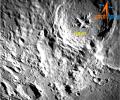
The ISRO on Monday released images of the Lunar far side area captured by the Lander Hazard Detection and Avoidance Camera (LHDAC).

Four years after it broke many hearts, Indian Space Research Organisation's Chandrayaan is all set to soar towards the moon in its third expedition on Friday in an attempt to put the country in an elite club of nations that accomplished lunar missions with a soft landing.
 © 2026 Rediff.com - Advertise with us - Disclaimer - Privacy Policy - Sitemap - Feedback - About us - Terms of use - Grievances